Jennie Dorris
  • Home
  • About
  • Research and Writing
  • Musical Storytelling
  • Music
  • Blog

WESA visits the BRiTE program

5/26/2023

 
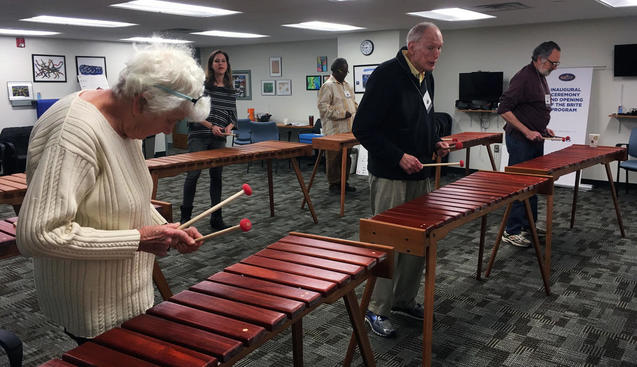
PictureSally Newman, Sam Williams and Barry Leonard play the marimba in Jennie Dorris's (back left) music class at BRiTE on Friday, February 17, 2017. CREDIT LIZ REID / 90.5 WESA
​A visit to the Brain Exercise and Training Program at the University of Pittsburgh

"Jennie Dorris’s four music students each stood, mallets in hand, behind a marimba, which looks a little like a xylophone. They were getting one last look at the original melody they wrote before Dorris erased it from the dry erase board and they had to play it from memory.
​
"'Take a look at it. Use the contours, look at your instrument,' Dorris told her students. 'Let’s see how it goes.'"

Read the full article and listen to the audio here. ​
Coverage of BRiTE from the Pittsburgh Post-Gazette

5/26/2023

 
Picture
Pitt program stimulates seniors with memory issues

article by Gary Rotstein (full version here) and photos by Nate Guidry

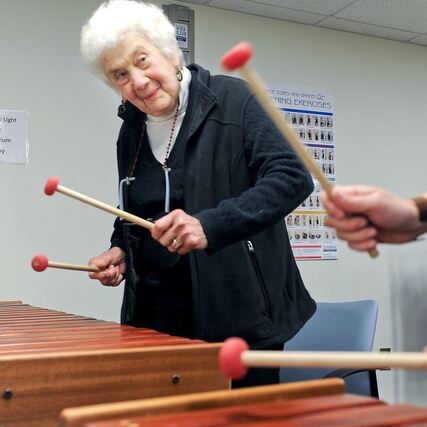
Barry Leonard, 81, with longtime concerns about memory lapses, spent part of a recent Monday morning joining other seniors playing the marimba, the mallets in his hands tapping out the notes and measures drummed into his brain by months of repetition.The music was a breeze for Sally Newman, 87, a former professional pianist who got a bigger mental challenge afterward from computer games testing her ability to recall objects flashing on the screen.

Bernie Glesky, 80, joining them in a new three-day-a-week University of Pittsburgh program, appreciated ending the morning with hand weights, leg lifts, stretch bands and other physical exercise, trusting in the theory that “the body is connected to the mind.”
​
The three octogenarians are among the first 15 participants enrolled in Pitt’s Brain Exercise and Training Wellness Program, or BRiTE, designed to assist people who have mild cognitive impairment. It’s a condition associated with memory problems in older adults, which can be a preliminary sign of Alzheimer’s disease or other forms of dementia, although not necessarily. The program is based on research and theories suggesting people can be helped at such a stage by well-rounded mental, physical and social stimulation." ​

Video about the BriTE program, including the marimba classes

5/26/2023


Music Participation Systematic Review published by the Journal of the American Geriatrics Society

5/26/2023

 
Picture
We are excited to share that our systematic review and meta-analysis, which examines the effects of participating in music on the cognitive functioning of older adults in the early and moderate stages of memory loss, is published in the Journal of the American Geriatrics Society. This paper came out of the close partnership between the University of Pittsburgh's Occupational Therapy Department and Carnegie Mellon University's School of Music. We are grateful to CMU professor Dr. Stephen Neely for sharing his music expertise as an author on this paper. 

Additionally, we presented a poster of this research at the Gerontological Society of America's 2021 Annual Scientific Meeting - thank you to GSA for this opportunity to share our work!

CMU Prep: Teens creating collaborative compositions about their community

3/7/2019

 
Each semester I work with fantastic young musicians at Carnegie Mellon University's Preparatory School to create their own original compositions that are inspired by people, places, and art in their community. They've worked with poets, painters, photographers, evolutionary biologists, and historical foundations over the past four semesters. 

Below, check out a little documentary that the Hillman Photography Initiative made about their collaboration with the students of CMU Prep: ​

Read More

Telling Stories at DSA (and that little ole radio show from all those years ago)

2/9/2019

 
Telling Stories is a unique interdisciplinary program that is designed to inspire students to both collaborate across disciplines and create original work. The process helps students learn to speak each others’ languages, inspires faculty members to work together in new ways, and gives non-performing artists a chance to take the stage with their performing colleagues. I’ve been producing an annual show at the Denver School of the Arts since 2008, and I often get this question: “So, how do you get students in writing, music, visual arts, and tech to all work together? And what does that even look like?”​

Well, I’m glad you asked! Check out some photos from past shows: 

Read More

Musical Storytelling Composition Workshop: How to Turn an Audience into Composers

11/15/2018

 
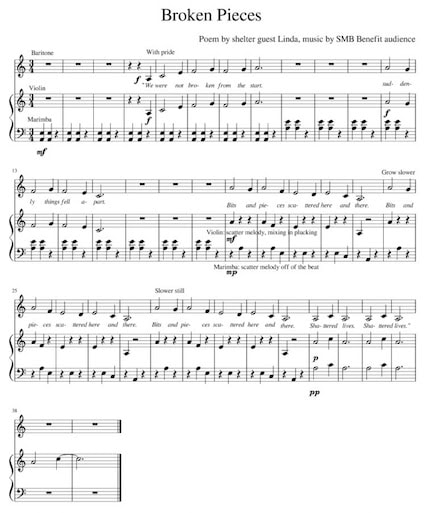
PictureHow do you get from a blank page to this composition with 100 people collaborating?
During our August concert set of Shelter Music Boston, one of the guests at a homeless shelter left a note that read: “Please if possible, compose about Broken Pieces.” Following the note was a poem that she had written:

“Broken Pieces”
We were not broken from the start
But suddenly things fell apart
Bits and pieces scattered here and there
Shattered lives.

The musical ideas and words of the homeless individuals served monthly by Shelter Music Boston had inspired all of the pieces we were performing for her, and we loved that she wanted her poem to be our next inspiration. We used a process called Musical Storytelling to compose with previous shelter audiences, and we knew that we wanted to share this process with an upcoming audience who would attend a Shelter Music Boston benefit concert. But why just describe it, when the audience could actually experience it? We brainstormed how we could have our benefit audience consider this poem and create the music for it. 

We set up a structure to set each line of the poem to music, with all of the musical decisions to be made by the audience and performed by a trio of myself on marimba, Julie Leven on violin, and RaShaun Campbell, baritone voice.

​But then the benefit audience arrived. We were used to doing Musical Storytelling with small groups. Now we had close to 100 people. And as soon as we started to ask questions about how to set the first line to music, EVERYONE had opinions. Not only did the audience learn to express their own ideas, they experienced exactly what had happened at the shelters -- they started working together as a group to shape the composition with common goals.

Watch this short video to see an abridged version of how the final two lines of the poem came to life from the audience's ideas:

And listen to the final, full performance of their composition, Broken Pieces! ​

Completing the Project: Bringing Collaborative Compositions back to Boston’s Homeless Shelters

8/28/2018

 
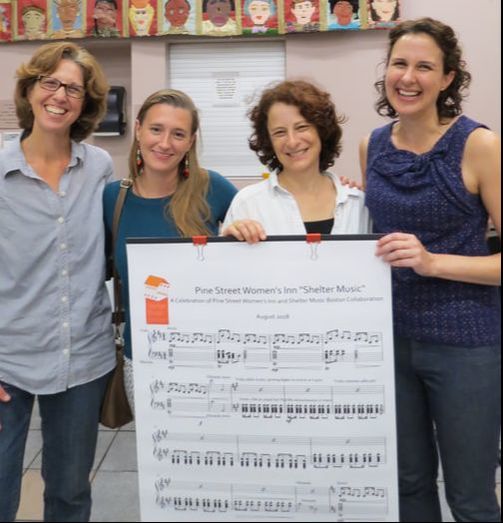
PictureFrom left -- violist Rebecca Strauss, composer Danielle Williams, violinist Julie Leven, and myself. We presented each shelter with a score of their composition.
Last year I wrote about the composition workshops that Shelter Music Boston brought into homeless shelters. Each shelter created a wealth of musical ideas, and we gathered those ideas -- as well as beautiful poems and comments from the guests -- and sent them to composers to commission chamber works.

This year we returned to the shelters to perform these works, now grouped into a suite called “Water For My Soul.”

When I started preparing the music, I immediately started smiling. Danielle Williams composed “Shells From the Sea” for baritone voice, viola, marimba, and cello. The first melody, sung stunningly by baritone RaShaun Campbell, was the melody the women at the Dimock Center had composed with violist Rebecca Strauss and me last June. More importantly, I remembered they loved their melody so much they all left singing it together.

Later in her piece, Danielle wrote a little fugue between myself, the viola, and the cello (played beautifully by Javier Caballero). In that fugue was a melody we had begun writing with a shelter in Lowell and had presented down to the Pine Street Women’s Inn to complete. When we played the first part of the melody, a woman at Pine Street immediately started singing a second part to the melody, essentially finishing its sentence. To hear that melody finalized as a fugue was the perfect treatment to a melodic line composed across the city by different shelter guests!


Read More

My Residency at The Neighborhood Academy -- Poetry and Original Music

10/29/2017

 
For three years I was in residence at The Neighborhood Academy leading Spoken Word, where students write original poems and then create musical compositions to accompany them. A little bit for folks who don't know about this awesome school: The Neighborhood Academy seeks to break the cycle of generational poverty by preparing low-income youth for college. 75% of students have a household income of $25,000 or less. Students go to school for a 12-hour day and 100% of students go on to college. Often students have never experienced a cultural activity before going to this school.

This year we have been lucky to work with Youth Express, who have come out to record the students, and Saturday Light Brigade, who had the students on a live radio taping.  All of the students' work is housed hereand here on Soundcloud.

Composing in Boston's Homeless Shelters

8/6/2017

 
Picture
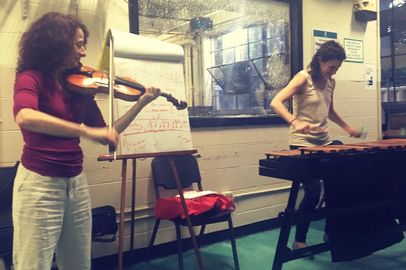
For a week in June, I gave hour-long concerts to which I brought no prepared music. And these were less-than-typical concert venues -- every night I was in a different homeless shelter in and outside of Boston. I had my marimba, a load of different-sounding mallets, and an oversized sketch pad propped up on an easel. I wasn’t alone -- two incredibly talented string players joined; a violinist for the first five concerts, and a violist for the sixth. With just our instruments, our huge notepad, and our imaginations, we had a goal: Could we create an experience for people who were homeless to compose music with us?

​This project was the brainchild of Shelter Music Boston, who for the past seven years has offered monthly classical concerts to homeless shelters. (I've joined them as a musician for the past five years.) Founder and artistic director Julie Leven (pictured at left playing with me at one of the shelters), had a vision for a new work to be composed that was inspired by the audience. Two of those movements would be sourced entirely from this week of concerts where the audience composed with us. We would give the materials from these concerts to a composer, who would score out the music. The project was funded by The Boston Foundation’s Live Arts Boston grant.

Getting Ready

Planning sessions took place over Skype between Julie (who lives in Boston), myself (I’m in Pittsburgh), and the piece’s eventual orchestrator Danielle Williams (who lives and teaches in Palestine).  

How could we get our audience to compose with us? While we knew that our audience was opinionated -- one of the best parts of a SMB concert is discussing the music with our audiences after the show -- we also knew we didn’t want to put them on the spot. We knew many of them would enter into this process without having played a musical instrument or receiving formal musical training.

We settled on the idea that we would be their “musical jukebox” (an idea that was inspired by my work at the Hillman Cancer Center). We would present different options on our instruments and ask open-ended questions that would let them guide our playing. Their opinions would be heard through us. We broke music into its puzzle pieces -- including melody, harmony, rhythm, texture, timbre, dynamics, and tempo -- to help focus our plans for each shelter. 

We also knew that the process would be different at every place we went. Some locations had a separate room, and were quiet. Some enforced substance-free living. Other concerts were given in the middle of their living spaces, abutted by the sounds of running showers and flushing toilets.


Read More
<<Previous
Forward>>
Proudly powered by Weebly